 By Colin Foster
Updated November 2026
Good ceiling lighting in kitchen work comes down to three things: enough light for the whole room, fixtures spaced so they don’t leave shadows, and a color temperature that suits what you do there. This guide walks through measuring the room, choosing fixtures and placing them so the result is even and comfortable. The method works for new builds, remodels and simple swaps of an existing fixture.
Measure the room and set your light level
Start with the floor area. Multiply length by width to get square feet. Kitchen designers commonly aim for roughly 30 to 50 lumens per square foot for general light, then add task light separately over counters and the range. Note the ceiling height too, because a 9-foot ceiling needs fixtures that sit flush or low enough to light the work zone without glare.
Shopping for one? See our guide: 7 Best Pendant Lights for Kitchen Island (2026): Expert Picks.
Choose the right ceiling fixture types
Most kitchens do well with one of three ceiling options:
- Flush or semi-flush LED fixtures for low ceilings and a clean look.
- Recessed downlights for even spread with no visible hardware, typically 4 or 6 inches in diameter.
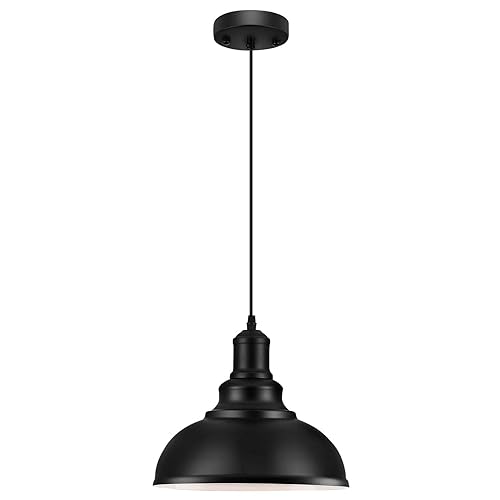
- Pendants or a linear fixture over an island, paired with flush lights elsewhere, when you want a focal point.
Avoid a single central fixture in a large kitchen. It leaves the counters in shadow and the corners dim.
Place fixtures for even coverage
Lay out the room on paper before cutting any holes. For recessed lights, a common starting rule is to space them about 4 to 6 feet apart, keeping them roughly 2 feet from walls so the wall surfaces get soft light. Position fixtures so they fall in front of the sink, range and main prep zone rather than directly above where you stand, which casts your shadow onto the work.
Quick placement checklist
- Sketch the room to scale with cabinets, island and appliances marked.
- Mark a grid of ceiling points at 4 to 6 foot spacing.
- Shift any light that lands on a cabinet door hinge or a wall-mounted hood.
- Confirm the layout with a helper holding a flashlight at counter height.
- Check that the switches can control zones (general, island, accent).
Pick color temperature and dimming
Color temperature is measured in kelvins. Many homeowners find 3000K warm white comfortable in living areas, while 3500K to 4000K tends to show food and countertop colors more accurately. Choose a consistent temperature for all fixtures so the room doesn’t look patchy. Put general light on a dimmer so you can lower it for evenings.
Layer ceiling light with task and accent light
Ceiling fixtures are the general layer and should not be your only source. Pair them with task lighting over counters and accent lighting on cabinets or open shelves. If you’re planning those layers, the Kitchen Lighting Plan: Task, Ambient and Accent Layers article covers how each one fits together, and Kitchen Ambient Lighting: General Light Done Right goes deeper on the ceiling layer itself.
Common mistakes to avoid
- Placing a single fixture over the center of the room instead of over the work zones.
- Mixing 2700K and 5000K fixtures, which makes the ceiling look uneven.
- Installing recessed lights too close to walls, creating scalloped wall washes.
- Skipping a dimmer, so the room is either too bright or too dim.
- Forgetting that a range hood or island pendant can block a light’s throw.
Recommended gear
A simple laser distance measurer helps you check fixture spacing across a long ceiling without a second person holding a tape.
An adjustable LED dimmer compatible with your fixtures lets you tune the general layer to the time of day.
FAQ
How many ceiling lights does a kitchen need?
It depends on the room size and fixture type, but a common approach is a recessed light grid spaced about 4 to 6 feet apart. Check the layout against your target lumens per square foot.
What color temperature is best for kitchen ceiling lights?
Many people prefer 3000K for a warm feel, while 3500K to 4000K shows colors more accurately for cooking. Keep all fixtures at the same temperature.
Can I replace one ceiling fixture myself?
A like-for-like swap is often manageable for someone comfortable with electrical work, but running new circuits or moving fixtures should be done by a licensed electrician.
Conclusion
Measure the room, choose fixtures that match your ceiling height and space them to cover the work zones evenly. Keep color temperature consistent and put the general layer on a dimmer. Combined with task and accent light, that gives you a kitchen that works well at every hour.
Related reading
Ready to choose one?
About Colin Foster
Colin Foster is part of our editorial team and reviews and edits our kitchen design & remodeling guides, checking product details against manufacturer specifications and owner feedback.